

Saturday, 03 September 2016 22:27
A New Look for This Year's Class Mission Statement Featured
Written by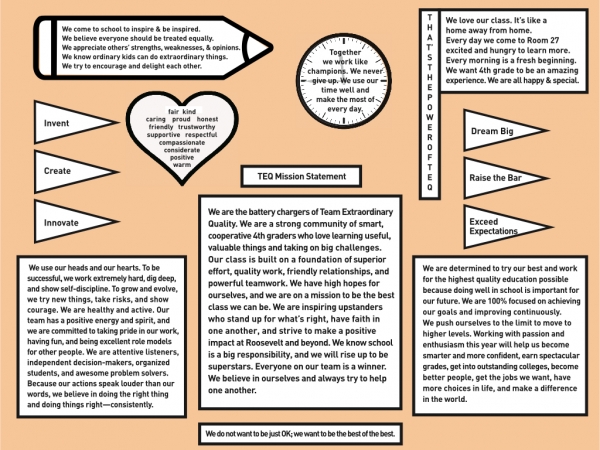
My students and I just completed our class mission statement, and I decided to try a different format this year. Rather than present our ideas as a series of paragraphs, I designed the document to look like the front wall of a classroom. The text was fit inside a whiteboard, two bulletin boards, a clock, a flag, and other "classroom-themed" shapes. As much as possible, the meaning of the text matched the object in which it was placed. For example, the words "we use our time well and make the most of every day" were put in the clock. My hope is that this novel format will resonate with my students and give our ideas greater meaning. Click here to see the full-sized version of our new class mission statement.
Published in
Blog
In this video I announce the release of my new e-book on amazon, 15 1/2 Ways to Personalize Learning. In the book I present a variety of proven, user-friendly teaching strategies, ideas, and activities that simplify the challenge of personalizing student learning and enable educators to meet children’s diverse needs confidently, effectively, and joyfully. This teaching resource is divided into four sections. Part 1: Personalize the approach students take to their work Part 2: Personalize academic instruction (This part includes my favorite method of integrating technology in the classroom.) Part 3: Personalize student goals Part 4: Personalize each child’s classroom experience There is also a link in the book that provides access to a free PDF with over 25 printable pages that make it easy to incorporate the book’s ideas in the classroom. Click here to see the book on amazon.com. Click here to see the video.
Published in
Blog
One of my favorite beginning-of-the-year activities to use in the classroom is the Passion Survey. Having children identify their favorite hobbies and topics and then using this information throughout the school year produces numerous academic and socio-emotional benefits. This video describes these benefits and presents a user-friendly way to organize and display the results. Watch this video now.
Published in
Blog
Saturday, 18 June 2016 20:51
NEW Video: Give All Your Students Their Own "Thing" Featured
Written by
This video features a fun strategy designed teachers can use in the classroom to personalize everyone’s classroom experience and guarantee positive attention. When we give kids their own thing, it can be a nickname, a job, a gesture, a signal, or a private joke—anything that makes a child feel special and acknowledged as an individual. The goal is for every child to have or be known for something that is uniquely theirs. Watch this video now.
Published in
Blog
Saturday, 18 June 2016 20:29
NEW Video: Help Children Improve Their Reading Skills Featured
Written by
This video features a wonderful resource we can use in the classroom to improve children's reading after we conclude our reading conferences with them. Conferring is a terrific way to personalize our strategy work for the benefit of each child. Follow-up is typically the primary challenge of conferring. For example, a student, during a reading conference, may do a fantastic job of making a thoughtful prediction before starting a new chapter, yet transferring that skill to her daily reading, where it matters most, may not come as easily. To help facilitate stronger transfer, we can use simple tools called visual reminder cards. Each card is a small, index-card-size sheet that contains the name of a specific strategy, a corresponding image, and a brief definition or description of the strategy. At the end of a conference, I like to present students with a visual reminder card focused on the strategy we…
Published in
Blog
Tuesday, 14 June 2016 17:14
2 NEW Short Instructional Videos for Young Mystery Writers Featured
Written by
"What is a Mystery?" and "What is the Crime?" are two engaging videos that are a part of "The Ultimate Mystery Writing Course for Kids," a series of engaging, easy-to-follow lessons I created for udemy.com, in which I take young writers step-by-step from the beginning of the writing process to the end and help them craft stories that keep readers guessing and on the edge of their seats! If your child is interested in writing a mystery adventure, you may also want to consider "The Ultimate Mystery Writing Guide for Kids" on amazon.com. In both the course and the guide, I combine the knowledge and skills I have developed during my 22-year teaching career with numerous examples from my Chase Manning Mystery Series to teach children about crimes, crime solvers, suspects, motives, clues, witnesses, alibis, red herrings, and all the other elements that make mysteries so much fun to…
Published in
Blog
Tuesday, 14 June 2016 17:02
New Short Video: What are the 5 Most Important Traits Needed for School Success? Featured
Written by
This short video features "The Drive for 5," a concept I created to help children and parents understand what I consider to be the 5 most important traits kids need to develop and display in order to have the best school year possible. You can find the set of visuals that I present in the video on my Pinterest page. I share the visuals with my students at the beginning of the school year and with their parents at Back to School Night. These ideas become a significant reference point that we use in class throughout the year. Click here to watch the video.
Published in
Blog
Saturday, 05 March 2016 01:00
The Awesomeness of Problem-Based Learning (Part 7) Featured
Written by
Last week I described the self-esteem benefits that surfaced when I presented the Thrively strength assessment results to my students in groups rather than individually. During these conversations another powerful benefit of using Thrively in the classroom emerged—improved group functioning. When children work together on an academic activity, teachers, of course, want each group to complete the task successfully and produce quality work. The primary goals of cooperative learning, however, have less to do with the final products the kids create and more to do with the development of important habits of character that will serve students well throughout their lives. For example, when members of a group work together, we want the students to treat one another with kindness and respect, be open to the ideas of others, solve disagreements peaceably, maintain their focus without straying off task, and take pride in the final product…
Published in
Blog
Tagged under
Saturday, 27 February 2016 01:59
The Awesomeness of Problem-Based Learning (Part 6) Featured
Written by
In last week's post, I mentioned that my each of my students took an online strength assessment at Thrively.com and received a detailed summary of the results that was 100% positive and motivating. I first incorporated the results of this strength profile into my instruction during the Community Resource Project, a problem-based learning unit that was part of our science curriculum. (To review, Thrively is a free website for teachers and parents that’s designed to help children discover their interests and passions, personalize the learning process, and maximize their amazing potential. Over the past few months, I have been collaborating with the founder of the company due to our mutual interest in strength-based education and teaching the whole child.) After my students took this online strength profile, my original plan was to meet individually with each child to discuss the results and determine the different ways we could…
Published in
Blog
Tagged under
More...
Saturday, 20 February 2016 00:42
The Awesomeness of Problem-Based Learning (Part 5) Featured
Written by
After completing the California Choice Project, my students moved to their next Problem-Based Learning unit, the Community Resource Project. Focusing on earthquakes, landslides, and other land changes, this science unit was introduced by the following problem statement: “You work for the government of a city that has seen many changes to the land over the years. You have lived in this city your whole life. Many people have been moving to your city lately, and they have never seen these types of changes before. Understandably, they are nervous about living in such an unfamiliar environment. You will create a resource that teaches new residents about these different types of land changes. Your resource must include the definition and pictures of landslides, earthquakes, creep, chemical weathering, mechanical weathering, dunes, volcanoes, runoff, erosion, and deposition. Also, your resource must include some type of rating or description of how dangerous each of these…
Published in
Blog
Tagged under
Saturday, 13 February 2016 22:22
The Awesomeness of Problem-Based Learning (Part 4) Featured
Written by
In my previous post in this blog series, I shared the problem statement of the "California Choice Project" and described how my students had an opportunity to identify what they already knew about the project and determine what they still needed to learn before they could begin. The next step was to form groups. Because this project occurred early in the school year, the PBL process was brand new to everyone, and the students were new to one another. So, I organized everyone into pairs that I thought would work well together. This would be the last time, though, that I would make the grouping decisions. Since then, the kids have had the choice of 1) whether they wanted to work alone or with others and 2) who would be in their group. I strongly believe that to maximize motivation, investment in the project, and work quality, children need to…
Published in
Blog
Tagged under
Before the kickoff to today's big game, you are likely to hear the announcers discuss each team's "Keys to Victory." For example, Phil Simms of CBS may describe how the Broncos need to run the ball effectively, protect Peyton Manning so he has time to pass, and play tough defense against Panthers quarterback Cam Newton. In the classroom, children have their own keys to victory. Over the past couple years, I've discussed this idea with my students before important assessments. Before an end-of-unit math assessment, for example, I ask everyone to identify the single most important thing they need to do to earn a high score. For some kids, it's paying close attention to detail. For others, it's reading the directions carefully, making sure they show all their work, or checking their work carefully at the end. Once the kids have each identified their individual key to victory, I encourage…
Published in
Blog
Tagged under
Saturday, 30 January 2016 01:29
The Awesomeness of Problem-Based Learning (Part 3) Featured
Written by
In this post I begin to describe “The California Choice Project,” a Problem-Based Learning unit my students completed in the fall as part of our social studies curriculum. Below you will find the problem statement I introduced to the kids on the first day of the unit. In this statement my goals were to 1) create an interesting context that would engage my students, 2) establish a clear final project that would drive everyone’s efforts throughout the unit and allow for meaningful student choice, and 3) include essential content about our topic, the four regions of California. “You are the founder and president of a new technology startup company in North Dakota. Ten people work for your company, and many of them have young children. To grow your business, you have decided to move your company to California and take your employees and their families with you. You need to…
Published in
Blog
Tagged under